
- Automation reproduces a process, it does not evaluate one. Speed multiplies whatever logic gets encoded.
- An AI agent runs the process it is given. It reaches root causes no better than a workflow rule does.
- The documented process and the executed process are rarely the same document. Map the executed one.
- Sequence matters: remove steps, standardize what remains, then automate. Automating first freezes the steps that should have been removed.
- A CRM configured against a process nobody runs produces clean records of the wrong thing, and the forecast built on those records inherits the error.
Automating a broken process makes it worse because automation reproduces a process, it does not evaluate one. Every workaround, every step with no clear owner and every rule that only works when a specific person intervenes gets encoded as official business logic and executed at machine speed. The defect stops looking like a defect. It becomes system output, and the people who used to catch it by hand no longer see it happen.
That is where an encoded workaround begins.
An encoded workaround is a manual exception a team invented to keep a broken process moving, later frozen into automation as official business logic. Once encoded, the exception stops reading as a fix and starts running as the process itself.
I have run more than a hundred revenue audits. In most of them the process the team runs and the process the CRM encodes are two different processes. Nobody decided that. It accumulated one exception at a time, and the automation project is usually the moment it becomes permanent.
The shape repeats. Someone built a spreadsheet in 2023 because two systems would not talk to each other. Two years later that spreadsheet is a required step in an automated flow, three teams depend on its column order, and the integration it was invented to replace has been available for eighteen months.
A spreadsheet is built, because two systems will not talk to each other.
The integration it was invented to replace becomes available.
The spreadsheet is a required step in an automated flow, and three teams depend on its column order.
AI Does Not Change the Sequence
The AI agent pitches landing on revenue teams’ desks this year all make the same promise: point it at the mess and it resolves itself. Treat it as a genie and you get what the story always warns about, which is a literal answer to a badly formed wish.
An agent executes the process it is given, the same as any workflow. Hand it a step with no owner and it picks one. Hand it an exception nobody wrote down and it improvises a branch. Here is the difference that costs money: a rule fails visibly when it meets a case it was not built for, and a model returns a confident answer instead.
Traditional automation encodes your workarounds. AI automation encodes them and defends them in fluent English.
Root causes live in the design of the process, in who owns what and in what moves work forward. No layer installed on top of that design reaches them.
Automation Is a Multiplier, Not a Judgment
Automation changes three properties of a process at once.
It executes faster than anyone reviews. It executes at a volume no one samples. And it removes the correction layer that was quietly doing most of the quality control.
That last property carries the real cost.
In a manual process, a coordinator sees the duplicate record and merges it. A seller notices the lead came in with the wrong owner and reassigns it. A finance analyst spots the missing field before the invoice goes out. The process was never clean. It was continuously repaired by people who had context and never logged the repair.
Automate the same process and the repairs stop. The duplicates arrive four hundred at a time and no one merges them. The wrong owner assignment now happens by rule, so it looks intentional.
I spent fifteen years in print before I worked on revenue systems, and one habit transferred intact: you check the plate, not the copies. Once the plate is cut, every sheet in the run carries whatever is on it, including the flaw nobody looked for before the press started. Catching it at plate stage costs minutes. Catching it at sheet four thousand costs the paper, the press time and the delivery date.
Automation is the plate. Your quarter is the run.
One more effect worth naming: output produced by a system carries authority that output produced by a person does not. A number typed by a colleague invites a question, the same number on a dashboard gets treated as measurement, and the defect becomes harder to trace precisely because it now looks official.
| Property | Manual process | Automated process |
|---|---|---|
| Speed | Slower than review | Faster than review |
| Volume | Sampled by whoever touches it | Unsampled |
| Correction layer | People with context, repairing silently | Removed |
| Authority of the output | Invites a question | Read as measurement |
Four Defects Automation Makes Permanent
1. Steps with no owner
A step with no owner survives manually because someone volunteers. Automated, it runs by rule and nobody is accountable for the exception the rule cannot handle. Any step where the honest answer to “who owns this output” is “whoever gets to it first” is not ready for automation.
2. Data entered twice
Manual duplication is visible as work, and visible work eventually gets questioned. Automated duplication moves inside the integration and becomes two records of the same fact, updated on different schedules.
The conflict surfaces later, in a board meeting, when two teams defend two numbers and both can show where theirs came from.
3. Exception branches nobody wrote down
Every process has cases handled outside the rule. The enterprise deal that skips a stage. The renewal that runs through a different owner. The account that gets manual pricing.
Those branches live in the memory of the people who run them. Automation encodes only the branch someone remembered to describe during the requirements conversation. Everything else takes the default path, and the default path was designed for the common case.
4. Handoffs with unmeasured wait time
Cycle time is made of two things: the time work is being done, and the time work is sitting between two owners. The waiting usually dominates.
Automation gets applied to the executing steps because those are the ones with a visible task attached. The step gets faster. The cycle does not move, because the wait was never touched.
Operating rule
Measure the wait before you touch the work. When a handoff sits idle longer than the step that follows it takes to complete, the handoff is the automation candidate, not the step.
Step with no owner
Can you name one accountable person for the output?
Data entered twice
Which record wins when the two disagree?
Undocumented exception branch
Which cases in the last quarter skipped the standard path?
Unmeasured handoff
How long does work sit between these two owners?
Where This Surfaces in the CRM
The CRM is where an unmapped process becomes expensive, because the CRM is where the process gets encoded whether anyone intended it or not.
Three patterns repeat.
Stages named after internal activity instead of buyer decisions. “Proposal sent” describes what the seller did. It says nothing about what the buyer decided. Automation fires on that stage change, so the trigger inherits the ambiguity of a stage a seller moves at their own discretion. Your forecast inherits it next.
Required fields defending a step nobody runs. The field was added to enforce a rule from a previous process design. The rule stopped applying. The field stayed. Sellers type something to move forward, so the field is complete and the data is fiction. We named that gap pipeline fiction in an earlier piece, and its most common origin is a field defending a step the team stopped running.
Workflows firing on a field another team owns. Marketing renames a value during a routine cleanup. A sales assignment rule silently stops matching. Nobody connects the two events for a month, because the two teams read different screens.
The productive move here is rescue, not replacement. Your CRM already holds the most honest record of the executed process available anywhere in the company: time stamps show where opportunities actually sit and for how long, change logs show which fields carry information and which carry compliance, and task records show which steps run and which get skipped without consequence.
That log beats any interview as a source for a process map, because it records behavior rather than intention.
Map the Process That Runs, Not the One That Is Documented
The map that matters is the As-Is: the process as executed this quarter, including the workarounds. The To-Be comes second, and it only earns its value once the As-Is is honest.
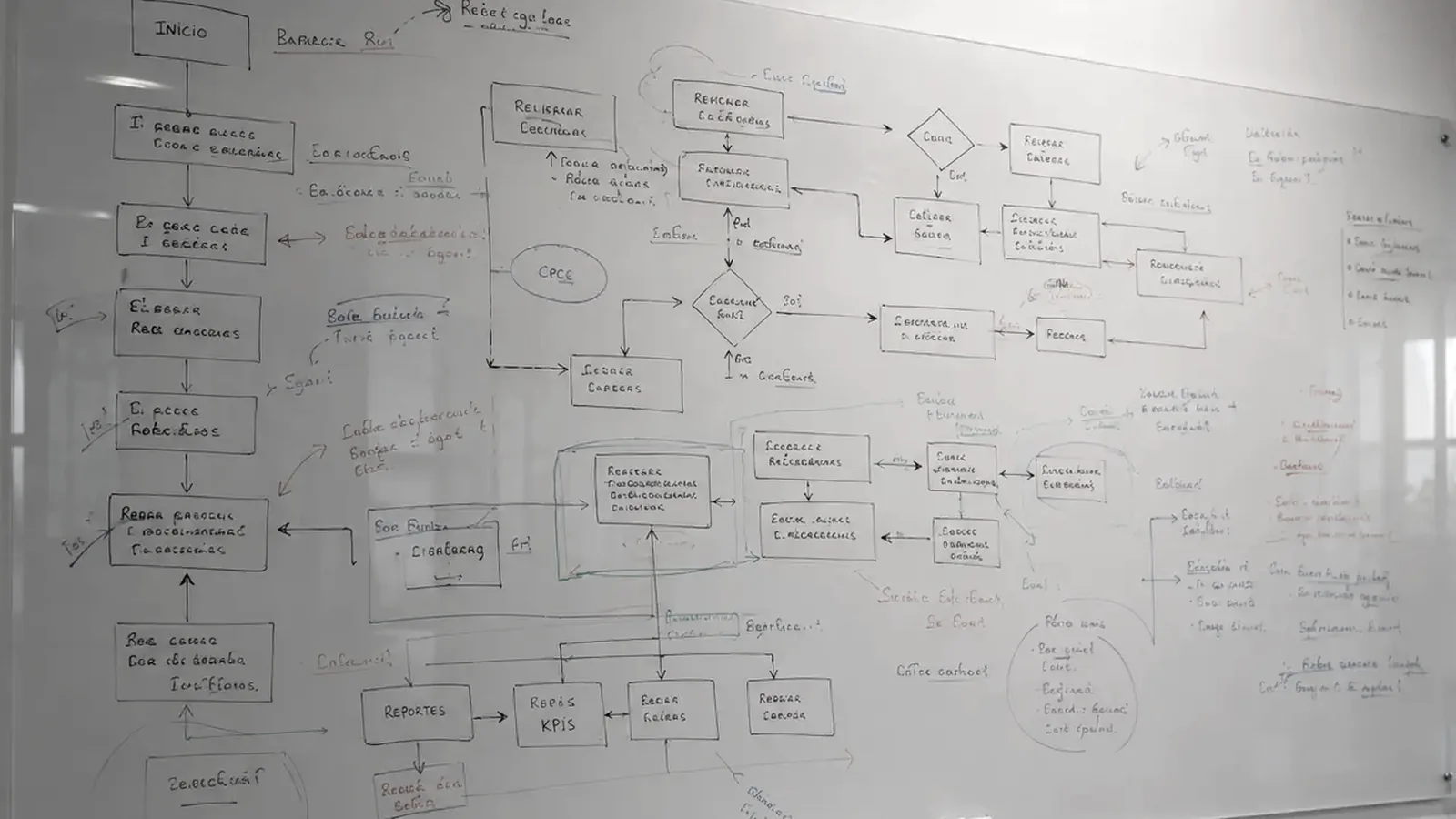
Three sources describe the executed process, and they disagree.
- What people say when you ask them.
- What the systems log.
- What the customer experiences.
The disagreement between the three is the map. When a team describes a two-day turnaround, the system logs six days, and the customer received the document on day nine, the gap contains every step nobody thought was worth mentioning.
How much detail a map earns
Detail is where mapping efforts stall. Teams start diagramming keystrokes, the map runs to eleven pages, and it ages before it is finished.
A step earns a box when it changes the state of the record, changes who is accountable, or changes what the customer sees. Everything else belongs in the configuration of the system, not in the map.
When a map is finished
The map is done when every box carries four things.
Which role is accountable for the output, expressed as a role and not a person’s name
The event that starts the step
What exists after the step that did not exist before
The verifiable condition that moves it forward
A box missing any of the four will encode an assumption. Your team will want to argue about notation instead, and notation matters less than those four fields. A whiteboard photo with four complete fields per box beats a certified diagram with empty owners.
Operating rule
One revenue process, two weeks, scope ending at the first handoff outside the revenue team. When a mapping effort runs past a quarter, the scope was set too wide, and the map will describe a company that has already changed.
Remove, Standardize, Then Automate
The sequence carries most of the value.
Remove first. Steps accumulate because a system once required them. Approval gates are the clearest case. An approval step that has never returned a rejection in the last two quarters is a delay with a signature attached, and removing it costs nothing but the conversation.
Standardize second. When four sellers run four versions of the same step, automation encodes one version and breaks the other three. Standardization is the work of deciding which version becomes the common path, and which cases stay deliberately manual.
Automate third. What remains after removal and standardization is a smaller surface than the one the team started with, and every piece of it has an owner and a rule.
Remove
Steps accumulate because a system once required them.
Standardize
Deciding which version becomes the common path, and which cases stay deliberately manual.
Automate
What remains, where every piece of it has an owner and a rule.
The exception
Some work can be automated before any mapping, and pretending otherwise slows teams down for no return.
A step qualifies when it has a single owner, a single input, no branching, and nothing downstream that depends on its output. Notifications, logging, calendar invites, internal reminders. Those are safe.
Anything that writes to a record another team reads deserves the map first. That is the line.
What Automating First Actually Costs
Three costs show up, and each one is recoverable while the process still runs manually.
Rework at volume. Correcting four hundred records costs more than correcting the four that would have surfaced manually in the same week, and the correction usually requires the person who built the automation.
Trust in the reporting. This is the expensive one. Once a dashboard shows a number your team can disprove from memory, the team goes back to its own spreadsheets, and every forecast conversation after that runs on private files you never see.
Unwinding. Automation is cheaper to design than to remove. Retiring an encoded workaround means finding every downstream consumer of the field it writes to, and those consumers are rarely documented.
Surfaced manually, same week
4Produced by the automation
400The recoverable window is the point. A process that runs manually and imperfectly still has its correction layer intact, and people who can describe what actually happens. That is the cheapest moment to map it.
What Changes Once the Map Exists
A mapped process gives you three things automation alone never produces.
One version of events. The monthly dispute between two teams ends, because both are reading the same map with the same owners on it. Meetings that used to reconcile numbers start deciding things instead.
Visible waiting time. Cycle time splits into work and waiting, and the waiting is usually the part you can compress without hiring anyone.
A forecast you can defend. Stages that describe buyer decisions rather than seller activity produce close dates you can commit to in front of a board, because the rule that moves a deal forward is a condition someone can verify.
Then automation does what it is genuinely good at, with or without a model behind it. It runs a process you already trust, faster than your team can run it by hand, and the speed compounds instead of multiplying an error.
Read Your Own Stack Before You Add to It
The clearest signal that a process was automated before it was mapped is a tool inventory much larger than the set of tools carrying real pipeline. Instruments get installed to fix a symptom, the underlying step never changes, and the stack grows a layer per year.
The Growth Engine Report reads that gap from observable evidence: full tech stack detection, tracking and pixel coverage, and the contradictions between what the stack claims to do and what the traffic and pipeline data show. No questionnaire, just your domain.
Run it before the next automation project gets scoped. The tools already installed will tell you which processes were patched instead of mapped.
Frequently asked