Revenue Engineering Partner — Est. MMXXIV

ENGINEERED, NOT GUESSED

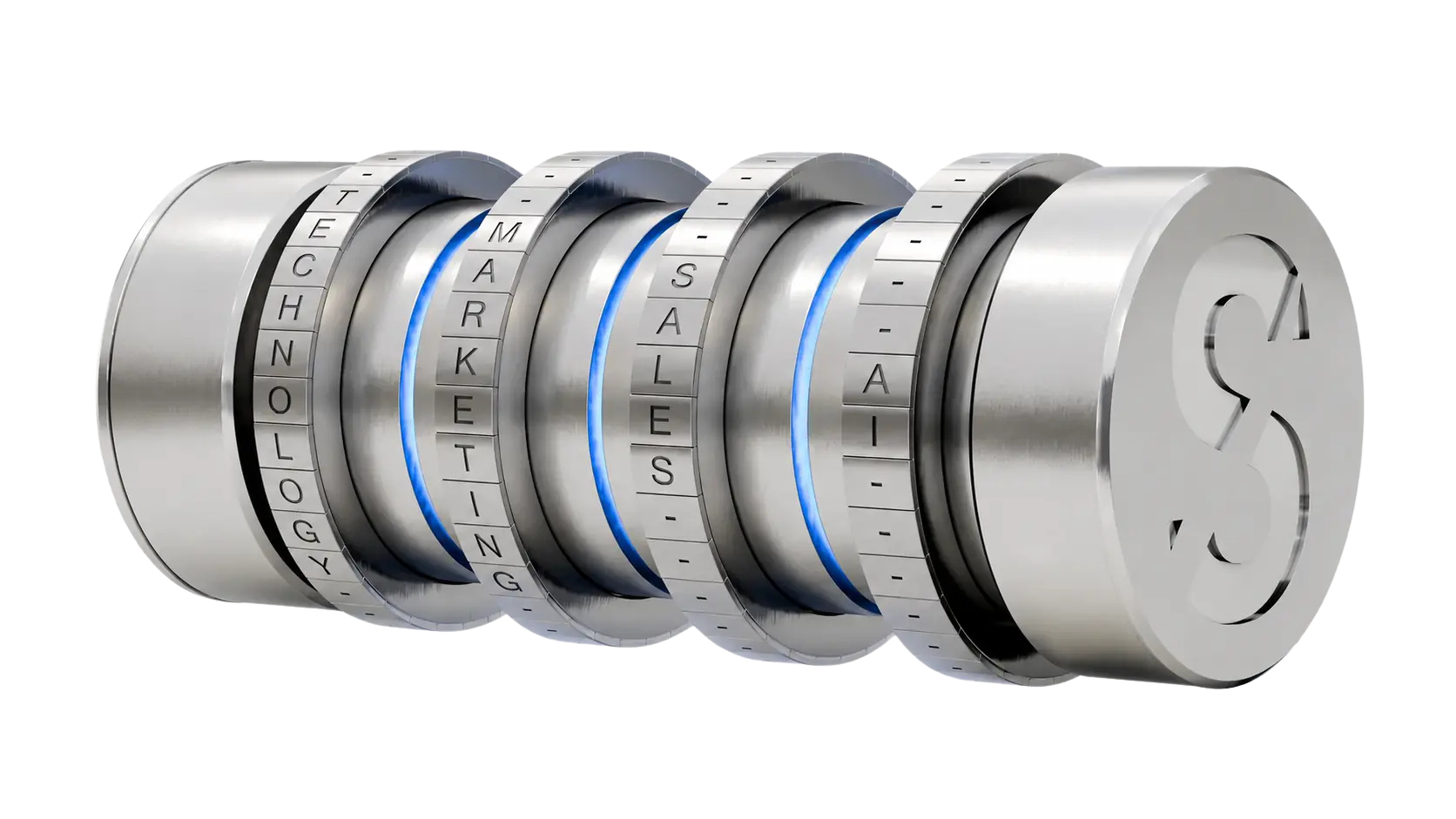
SPECIMEN — CRYPTEX MK.V / 4-STAGE COMBINATION LOCK

Your revenue is locked.
We have the combination.

It’s not marketing,
…or sales,
…or tech stack.

It’s that they never turn together.

Every quarter misses by a margin too consistent to be luck. You’ve swapped the team, the tools, the tactics. The number won’t move, because nothing is broken alone.

Marketing makes noise sales can’t close. Sales sells what operations can’t deliver. Tools hoard data nobody trusts.

Four functions. Four scoreboards. One number nobody owns.

Diagnostic // 05 States

Where is your company stuck right now?

Five moments. One of them is yours. Find the one that reads like your morning, and the combination starts to turn.

StateNo single source of truth

You grew fast and bought tools as you needed them. A CRM one year, a marketing platform the next, something for ops after that. None were chosen to work together, so they don’t. Your team keeps the real pipeline in their heads and a side spreadsheet, because the system never matched how they sell. Reports get stitched together by hand, and people still question the numbers.

[ S.01 ] ROT

Revenue Operations Transformation

We engineer the foundation so your systems match how the business runs, and the numbers reconcile across teams.


StateGrowth rides one channel

Trace your last ten clients back to where they came from. Most lead to a referral, the founder’s network, or one channel nobody can fully explain. That worked up to here, and now there’s a ceiling you can feel. When the board asks how you double it, the only honest answer is “do more of the same and hope.”

[ S.02 ] GEA

Growth Engine Acceleration

We connect marketing and sales into one engine on shared targets and shared data, and turn what your best rep does on instinct into something every rep can follow.

StateExisting clients go untouched

The cheapest growth available to you is already signed and paying, and right now it mostly takes care of itself until the quarter it doesn’t. Expansion is accidental. Churn is a surprise.

[ S.03 ] REF

Retention & Expansion Flywheel

We build the flywheel that scores account health, flags the moment an account is ready to grow, and gives your client team a repeatable way to expand the accounts you already have.

StateIntuition dressed as data

Tell me where your revenue lands in six months. If you can’t get within 10%, you’re steering by numbers you can’t fully see. The data is there. It sits across a dozen tools that were never connected, so nobody watches the whole board at once. Pile AI on top of that and you only automate the wrong conclusions faster.

[ S.04 ] BIA

Business Intelligence & Automation

We pull every source into one view that forecasts inside that margin, then put AI to work compounding the result.

StateRunway shrinking

Coverage down to weeks. Nothing fresh entering the funnel. A sales team with little left to work. The channels that got you here clearly are not getting you out.

[ S.05 ] PAS

Pipeline Acceleration Sprints

We run a coordinated sprint across six to eight channels at once to get qualified pipeline back in front of your team fast, so your next decisions come from a stable position instead of a tight corner.

Six stages.

A measured engineering procedure. Each stage is run, read off the instrument, and signed before the next begins. This is how the combination is set, one ring at a time, until revenue turns.

Procedure
SEN·RE / 06
Stages
06 / 06
Arc
Diagnose → Calibrate
State
Running
  1. Phase I Diagnose
  2. Ring 01 · Read

    Revenue Audit

    We audit your processes, tools, and data, and map how deals, decisions, and information actually move. Not how they should. How they do.

  3. Ring 02 · Set

    Strategy Design

    What needs to change, in what order, and why. Every decision tied to a measurable impact on your pipeline, forecast, or profitability.

  4. Phase II Specify
  5. Ring 03 · Draw

    System Blueprint

    The strategy translated into a complete technical architecture.

  6. Gate · Your sign-off

    Validation

    Your leadership reviews and approves every component before we touch a single configuration. No surprises.

  7. Phase III Run
  8. Ring 04 · Torque

    Deployment

    Built inside your operation, with your team, in your tools. Tested in real context. Documented to work without us.

  9. Loop · Live

    Calibration

    Measure, compare against projections, recalibrate. Revenue Engineering doesn’t end at go-live. It evolves with your company.

Same procedure, every engagement. The order does not bend, because the result depends on it.

What is Revenue Engineering?

Revenue Engineering is the discipline of designing, building, and operating one integrated system across marketing, sales, and technology so a company produces predictable revenue.

It applies engineering method to the commercial operation: diagnose the system, architect the fix, build it inside the stack the company already runs, and measure the output.

The system has four components:

  1. Demand generation
  2. Qualification and sales process
  3. The technology that executes both
  4. The measurement layer that reports what actually happened

AI enters as infrastructure inside that system, applied where it compounds Output: enrichment, qualification, forecasting, and follow-up.

The number runs the room. These are the rooms.

88 Clients
343 Projects
delivered
$417M Revenue
engineered

Cumulative · 2021 → 2026

Straight answers

How is revenue engineering different from revenue operations?

Revenue operations manages and optimizes the system a company already runs: the data, the tooling, the reporting, the process hygiene. Revenue engineering designs and builds that system across marketing, sales, and technology, then stays until the team operates it without help. RevOps keeps a working system healthy. Revenue engineering builds the system that works.

How is this different from hiring a marketing agency or a consultant?

Marketing agencies optimize the top of the funnel. Sales consultants train teams. CRM partners configure tools. Management consultants deliver strategy documents. Each one owns a single part. Sention owns the connection between all of them and reports against the revenue number itself.

How do you align sales and marketing?

Alignment holds when both teams work from one definition of a qualified lead, one shared pipeline stage model, and one set of numbers reported from the same system. Sention installs those three elements inside the CRM the company already runs, then builds the handoff process on top. Alignment becomes structural once the system enforces it.

Our CRM is not being used by the team. Can that be fixed?

Yes. A CRM the team avoids is an adoption and design problem. Sention maps the CRM to the way the company actually sells, rebuilds fields, stages, and automations around that reality, then trains the team inside the rebuilt system. The tool starts producing usable pipeline data once it reflects the real sales process.

Who does Sention work with?

SMB service companies with 21 to 500 employees across the United States and Europe, including the United Kingdom. The United Arab Emirates is a secondary market. Specifically leadership teams past early stage growth, with a commercial operation already running, that want a partner who builds the system alongside their team and reports against the revenue number.

You already know something needs to change.

One conversation is all it takes to see where your revenue system is breaking and what it’s costing you.

We’ll be direct.

If we can help, we’ll show you exactly what the path looks like. If we can’t, we’ll tell you that too.

No pitch deck. No pressure.

Time to unlock this

One meeting. Limitless possibilities. No wasted time.

The Sention cryptex, unlocked.
State
Open
Forecast
On
Revenue
Compounding
Tolerance
Nominal