
Sention · Sales Methodology Simulator
Three qualification methodologies.Only one fits how you sell.
MEDDIC, MEDDPICC and SPICED were built for different businesses. Picking the wrong one costs more than using none at all.
This simulator does two things. First it reads how your company actually sells and names the methodology that fits, with the criteria spelled out. Then it makes you qualify a real open opportunity against it and returns a score.
We do not sell any of the three. If your operation does not need one yet, the result will say so.
- Method
- Vendor-neutral
- Runtime
- ~6 min
- Built for
- Founders, CROs
- Your score
- On screen, free
01 The three, and what each one is for
MEDDIC
Complex, committee-based selling into buyers with no formal buying process. Six evidence variables, from the cost of the problem to the champion who defends you. It ends at signature.
MEDDPICC
The same, plus the two things enterprise deals actually die on: the paper process after the yes, and the competition, including the customer doing nothing. The heaviest of the three.
SPICED
Recurring revenue, where most of the value lands after the first signature. The only one of the three that spans the full lifecycle, from first touch to renewal.
Some businesses need two of them running at once, one for the sale and one for the lifecycle. Some need none yet. The simulator will tell you which case you are.
02 How it works
-
01
Describe how you sell
Eleven fields: billing model, deal size, cycle length, committee size, where your opportunities come from, and what you lose deals to. Nothing to pull from your systems.
-
02
Read the verdict
The methodology your profile points to, and the specific answers of yours that decided it. If two are needed, you get both and the reason.
-
03
Score a real open deal
One question per evidence variable, about a single opportunity you expect to close this quarter. The score comes back on screen, in full, with no email.
03 What comes back
- R01 The methodology that fits your business, and the criteria that decided it.
- R02 A qualification score for your deal, plus a score per evidence variable so you can see where it is thin.
- R03 The capping factors: single answers that limit the deal no matter how good the total looks.
- R04 What evidence you are missing on each variable, and the exact question that closes it.
- R05 Three moves for the next two weeks, each with the question to ask and who to ask.
- R06 The blind spots of the methodology we just recommended, because none of them covers everything.
04 The six possible verdicts
Every qualification tool on the market belongs to the company that sells one methodology, so the answer is always to use theirs. This model can return the lighter option, or none at all.
MEDDIC
Several people influence the decision and the criteria are known, but the contract itself moves without a formal review. Six evidence variables, ending at signature.
MEDDICC
The same, plus you regularly lose to a named alternative or to the customer deciding to do nothing.
MEDDPICC
Procurement, legal or security review can move your close date, or you sell into a regulated buyer. The heaviest of the three, and overkill everywhere else.
SPICED
Revenue recurs, a meaningful share of it comes from renewal and expansion, and the account keeps producing value after signature. It does not model the buying committee.
MEDDPICC + SPICED
Both conditions hold at once. The two cover different halves of the deal and do not conflict: one runs the sale, the other runs the lifecycle.
None of them
Deals close in a couple of conversations, one person signs and the contract is simple. A qualification framework would cost you more in administration than it returns.
Hard rules run first, weighted scoring second. Where two methodologies tie, the model returns the lighter one. On 655,000 opportunities analysed by Ebsta and Pavilion in 2025, only 36 per cent of deals that passed discovery carried both a score and supporting notes: the lighter methodology that gets used beats the complete one that gets abandoned.
05 Questions, answered
Which qualification methodology should my company use?
It depends on three things: whether a formal procurement, legal or security review can move your close date, whether your revenue recurs and expands after the signature, and how many people can stop the deal. If a review can move your date, you need MEDDPICC. If revenue recurs and expansion is a meaningful share of it, you need SPICED. If both, you need both. If deals close in two conversations with one signer, you need neither.
What is the difference between MEDDIC, MEDDICC and MEDDPICC?
MEDDIC has six variables. MEDDICC adds competition, which covers every alternative for the budget including the decision to do nothing. MEDDPICC adds paper process on top, which covers everything between a verbal yes and a signed contract. Each addition earns its place only when that risk is real in your deals.
Can a company be better off using no methodology at all?
Yes. When deals close in a small number of conversations, one person holds real authority and the contract is simple, a qualification framework costs more in administration than it returns in visibility. No vendor of a methodology will tell you this, because they sell the methodology.
How does the score work?
Every question is anchored in something observable rather than in how confident the seller feels. Each answer falls into one of four levels: you do not know, you are assuming it, the customer told you, or it is documented and you tested it back with them. A few variables can cap the band no matter what the total says: a deal with no economic buyer, no champion or no paper process is at risk at 88 per cent just as it is at 40.
Does a high qualification score mean the deal will close?
No. Ebsta and Pavilion analysed 655,000 opportunities in 2025 and found that deals in the top qualification band closed around 50 per cent of the time against around 8 per cent in the bottom band. That is a correlation across a large sample, not a causal claim about your deal. A score tells you what you do not know yet. It does not close anything.
Step 1 of 3 · Profile
How your company sells
Eleven fields. This is what determines your methodology, so answer for the business you run today, not the one you are building toward.
Your methodology
Step 2 of 3 · Qualification
Pick one specific opportunity
Not your best one, not your worst. A real deal, open right now, that you expect to close this quarter. Every answer is about that deal.
If you average several deals in your head, the result will be useless to you.
Answer with the keyboard if you prefer: 1 to 4 to pick, ← to go back.
Step 3 of 3 · Result
0%
Where your risk is
In the Ebsta and Pavilion study of 655,000 B2B opportunities (2025), deals in the top qualification band closed 50% of the time; those in the bottom band, 8%. That is correlation, not causation: well-qualified deals are well-qualified partly because they are good deals.
You have your score. Now the part that matters.
The full analysis covers every variable, the exact evidence you are missing on each one, the specific questions still to ask on this deal, and your plan for the next two weeks.
Partner tool
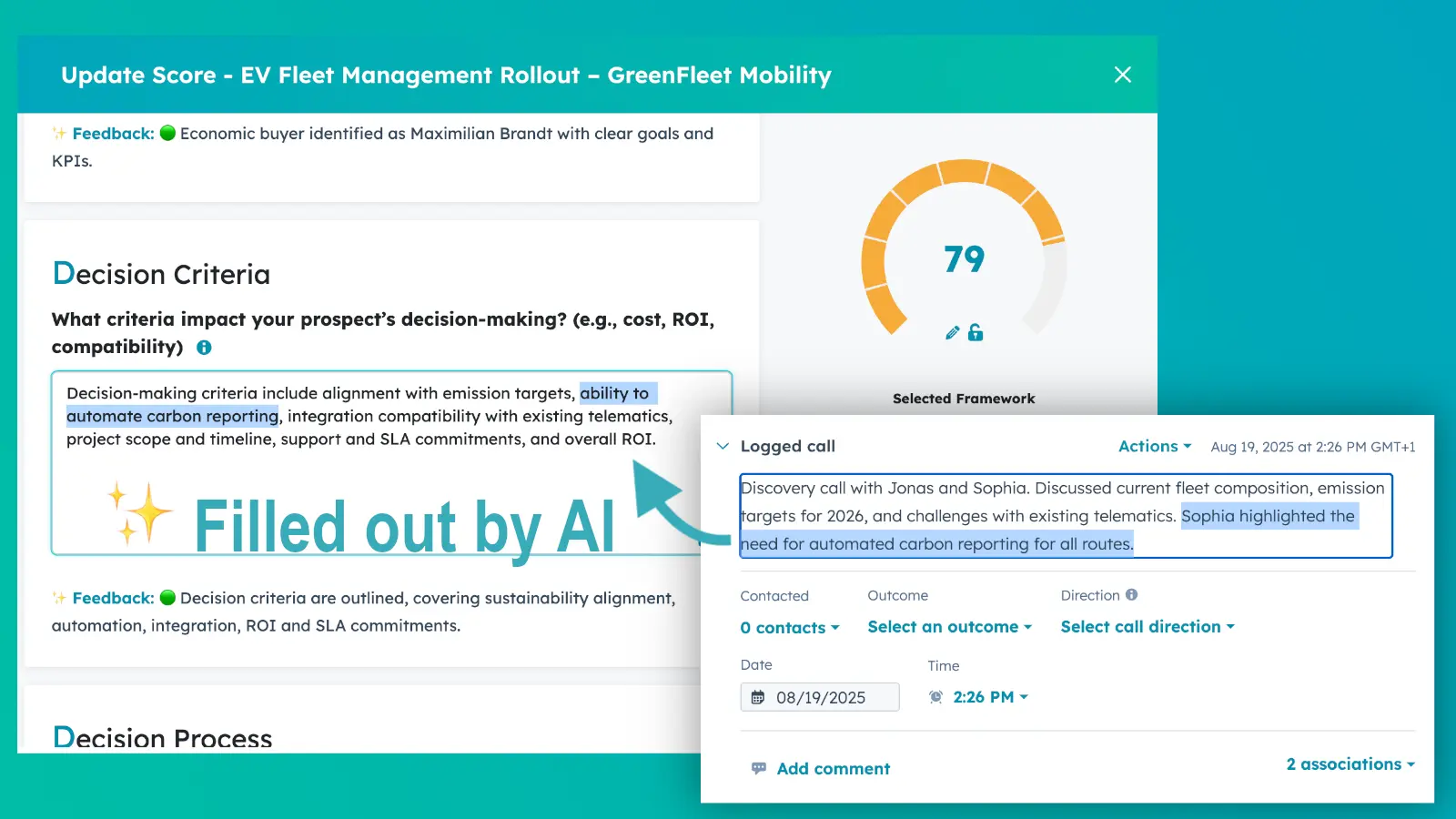
Turn your sales assessment into action
MEDDICC Score helps your team qualify opportunities directly in HubSpot, identify deal risks, uncover missing information, and receive AI-powered recommendations for the next best actions.
Through the partner link below you get your first month free, followed by 50% off for the next two months.
Start using MEDDICC ScoreAnalysis
Variable by variable
What each score means, and the specific evidence you are missing to raise it. Open a row to read it.
Your next two weeks
The three highest-impact moves on this deal, each with the exact question to ask and who to ask.
Why this methodology
And what it will not cover
No methodology covers everything. These are the blind spots of the one we just recommended.
Findings from your profile
One last thing
The gaps in a single deal are rarely about that deal. If the same hole shows up in your last five, it is not the rep: it is the process.
At Sention we engineer the full revenue system: process, stack and data. If you want the organizational read instead of the deal-level one, let us talk.