
- Use BANT for short, transactional deals with a single decision-maker.
- Upgrade to MEDDIC for complex negotiations usually closing within 90 days.
- Switch to MEDDPICC when the cycle exceeds 90 days, or when procurement, legal, security, and competition can block the signature.
- Adoption determines the result: qualification only works when criteria are enforced as stage gates in the CRM.
BANT loses precision when four fields have to explain a deal involving six stakeholders, procurement, security, legal, and a competitor nobody recorded in the CRM.
That is where pipeline fiction begins.
Pipeline fiction is the gap between what a forecast reports and what the qualification data can actually support. It appears when opportunities advance through stages without evidence for the criteria that determine whether they can close.
The opportunity appears advanced. The proposal has already been sent. The sales representative says everything is progressing as expected. Yet the economic buyer remains unidentified, the decision date lacks confirmation, and the contract still has to pass through several internal processes the team does not understand.
An opportunity under those conditions adds volume to the pipeline while contributing very little visibility to the forecast.
This comparison covers negotiations where one company sells to another and several people inside the buying organization shape the decision.
The selection can be summarized as follows:
- BANT for short, transactional deals with a single decision-maker.
- MEDDIC for complex negotiations that, as an operating rule, usually close within 90 days.
- MEDDPICC when the cycle exceeds 90 days or when procurement, legal, security, and competition can block the signature.
- SPICED for SaaS platforms and other recurring revenue models where value continues after the first contract.
Selecting the model is the first step. Results depend on how it is embedded into the sales process and the CRM.
Short, transactional deals with a single decision-maker.
Complex negotiations that, as an operating rule, close within 90 days.
Cycles over 90 days, or procurement, legal, security and competition able to block the signature.
SaaS platforms and recurring revenue models where value continues after the first contract.
What MEDDPICC adds over MEDDIC
The Four Models, Explained Without Unnecessary Theory
BANT
BANT stands for Budget, Authority, Need, and Timeline.
It answers four basic questions:
- Can they afford it?
- Can they make the decision?
- Is there a real need?
- When do they plan to act?
BANT works when the person in the conversation controls the budget and can approve the purchase. It is fast, easy to store in the CRM, and sufficiently precise for deals resolved in one or two conversations.
Its precision decreases when a company tries to represent an entire buying committee inside the Authority field.
An organization may have a user who identifies the problem, a manager who leads the project, a CFO who releases the budget, an IT team that validates the integration, and a legal department that approves the contract.
That structure requires more information than a single authority field can provide.
MEDDIC
MEDDIC stands for Metrics, Economic Buyer, Decision Criteria, Decision Process, Identify Pain, and Champion.
In practical terms, it tracks:
- Metrics.
- Economic buyer.
- Decision criteria.
- Decision process.
- Identified pain.
- Internal champion.
MEDDIC expands qualification from the individual contact to the buying organization.
BANT identifies whether the contact has authority. MEDDIC documents who actually controls the budget.
BANT records the existence of a need. MEDDIC translates that problem into economic impact.
BANT asks when the buyer intends to act. MEDDIC details the steps required to reach the decision.
As a practical rule, MEDDIC usually fits negotiations lasting between 30 and 90 days, involving several stakeholders and a relatively manageable contracting process.
The 90-day threshold works as an operating signal. As a negotiation extends across several months, the probability of additional stakeholders, processes, and risks increases.
MEDDPICC provides the structure needed to record that complexity.
MEDDPICC
MEDDPICC adds two critical variables to MEDDIC:
- Paper Process.
- Competition.
The Paper Process describes everything that happens between the decision to buy and the signed contract.
It may include:
- Vendor onboarding.
- Legal review.
- Security review.
- Contract negotiation.
- Procurement approval.
- Compliance questionnaires.
- Economic buyer signature.
In enterprise negotiations, several weeks or months can pass between verbal agreement and contractual signature.
A reliable forecast needs visibility into that journey.
Several weeks to several months
Competition includes any alternative competing for budget or internal priority:
- Another vendor.
- An existing tool.
- An internal development project.
- Another corporate initiative.
- The decision to postpone the investment.
MEDDPICC is especially useful when the average sales cycle exceeds 90 days or when procurement, legal, compliance, or security can change the expected closing date.
Complexity can also appear in shorter cycles.
A 60-day negotiation with a demanding contracting process may require MEDDPICC. A 100-day deal with few stakeholders and a simple contract may still be managed with MEDDIC.
Cycle length signals risk. The buying structure confirms which model is required.
SPICED
SPICED stands for Situation, Pain, Impact, Critical Event, and Decision.
It tracks:
- Situation.
- Pain.
- Impact.
- Critical event.
- Decision.
SPICED fits especially well in SaaS platforms and recurring revenue companies.
In these models, revenue continues developing after the signature.
Economic results depend on adoption, renewal, expansion, and churn reduction. An initial sale with limited measurable impact can become a cancellation twelve months later.
SPICED connects the sales conversation with the outcome the customer needs to achieve. That context can follow the account through discovery, onboarding, Customer Success, renewal, and expansion.
For a SaaS company, this continuity prevents a frequent problem: sales promises one thing, implementation receives incomplete notes, and Customer Success has to reconstruct the buying reason from scratch.
SPICED creates a shared language around expected impact.
The Three Variables That Should Determine the Choice
The model must reflect the real structure of your opportunities.
Three variables support that decision.
1. Sales Cycle Length
Short cycles require qualification speed.
Adding eight criteria to a sale that closes in ten days can create more administrative cost than informational value.
Long cycles require greater depth.
In a six-month negotiation, discovering the economic buyer during month five can destroy an entire quarter of forecast accuracy.
As an operating rule:
| Average sales cycle | Recommended starting model |
|---|---|
| Under 30 days | BANT |
| Between 30 and 90 days | MEDDIC |
| Over 90 days | MEDDPICC |
| SaaS or recurring revenue | SPICED, alone or combined |
2. Buying Committee Complexity
A single decision-maker can be represented through BANT.
Three or more stakeholders with different criteria usually require MEDDIC.
The participation of procurement, legal, compliance, security, or several approval levels increases the value of MEDDPICC.
The number of people copied on an email provides little insight.
The relevant metric is the number of people with the power to stop the deal.
3. Revenue Model
In a one-time sale, the signature concentrates most of the expected economic value.
In SaaS, subscriptions, and retainers, the signature begins the CAC recovery process.
Profitability depends on customer adoption, retention, and expansion. SPICED fits this logic because it keeps impact visible after closing.
SPICED and MEDDPICC Can Work Together
Hybrid models work when each one covers a different part of the deal.
SPICED helps the team understand:
- Why the customer needs to change.
- What impact they expect.
- Which event creates urgency.
- How results will be measured after purchase.
MEDDPICC helps the team control:
- Who controls the budget.
- How the decision will be made.
- Which process the contract must pass through.
- Which alternatives compete for the investment.
A SaaS platform with a low average contract value and a 30-day cycle can use SPICED as its primary model.
An enterprise SaaS platform with a six-month sales cycle may need both:
- SPICED to diagnose impact and preserve it throughout the customer lifecycle.
- MEDDPICC to manage the economic buyer, buying committee, contract, and competition.
The goal is to cover the blind spots affecting forecast accuracy, conversion rate, and LTV.
Selection Rule
Fig. 03Filter the rule by your three variables
Average sales cycle
People who can stop the deal
Revenue model
| Opportunity structure | Recommended model | What it protects |
|---|---|---|
| Cycle under 30 days, one signer, and a transactional ticket | BANT | Sales velocity and low qualification cost |
| Cycle between 30 and 90 days, several stakeholders, and defined criteria | MEDDIC | Opportunity quality and forecast accuracy |
| Cycle over 90 days or participation from procurement, security, and legal | MEDDPICC | Closing date, contracting process, and competitive risk |
| SaaS platform or recurring revenue business | SPICED | Adoption, renewal, expansion, and LTV |
| Enterprise SaaS with a complex buying committee | SPICED plus MEDDPICC | Lifecycle impact and deal control |
When BANT Is Still Enough
The age of BANT has little relevance when its four variables still represent the sales process accurately.
You can keep it when:
- Opportunities close in a small number of conversations.
- A single buyer holds real authority.
- The contracting process is simple.
- Closing dates rarely move.
- Forecast accuracy remains within the expected tolerance.
The need to evolve appears when:
- Opportunities reach proposal stage and then stall.
- The sales representative mentions an internal consultation after the deal has already entered commit.
- Procurement or security enters after verbal agreement.
- The closing date moves repeatedly.
- The team does not know who can sign.
- Renewal conversations begin without evidence of generated impact.
Each symptom reveals information the current qualification system has yet to capture.
Adoption Determines the Result
The same pattern appears repeatedly across sales organizations: companies define their qualification model correctly and allow the team to use it as an optional exercise.
There is a presentation.
There is a document.
In some cases, there is also a tool with an excellent user experience.
The sales representative can still move the opportunity forward with incomplete information.
MEDDPICC then becomes a decorative form inside the CRM.
Artificial intelligence can detect signals in a call, summarize a conversation, and suggest a score. Its impact depends on sales discipline and the quality of the available data.
Adoption requires operational design.
Specifically:
- Every criterion must exist as structured data inside the CRM.
- Critical stages must require minimum information before the opportunity can advance.
- The economic buyer and champion must exist as identified contacts with clearly defined roles.
- The decision process and Paper Process must include steps, owners, and dates.
- The sales leader must have an adoption and data quality KPI.
- When the compensation structure allows it, part of the variable compensation should depend on maintaining complete and verifiable information.
These rules protect sales capacity and improve resource allocation.
The team concentrates its effort on opportunities with a real ability to advance and reduces meetings with prospects that should never have entered the pipeline.
Initial resistance is part of the process. In our experience, it begins to decrease during the first three to six months, when the team sees that qualification reduces unproductive meetings and focuses attention on buyers with a higher probability of closing.
The CRM then begins to function as a commercial control tower.
A Qualification Model Needs Structured Data
Qualification creates visibility when every criterion has:
- A value.
- A source.
- An owner.
- An update date.
- A validation rule.
Recording “we have a champion” leaves too many questions unanswered.
Who is that person?
How much influence do they have?
What actions have they taken to defend the purchase internally?
What consequences would they face if the project stopped?
Recording “decision expected in September” also provides insufficient evidence for a reliable closing date.
What needs approval?
Who participates?
Which step happens first?
What depends on the legal team?
What evidence confirms the date?
When these answers exist as structured data, you can filter the pipeline and identify which opportunities are inflating coverage.
When they remain in the sales representative’s memory, the forecast continues to depend on individual perception.
Building that structure is the work behind a sales qualification engine: the criteria stop living in a training deck and start working as fields the pipeline can be filtered by.
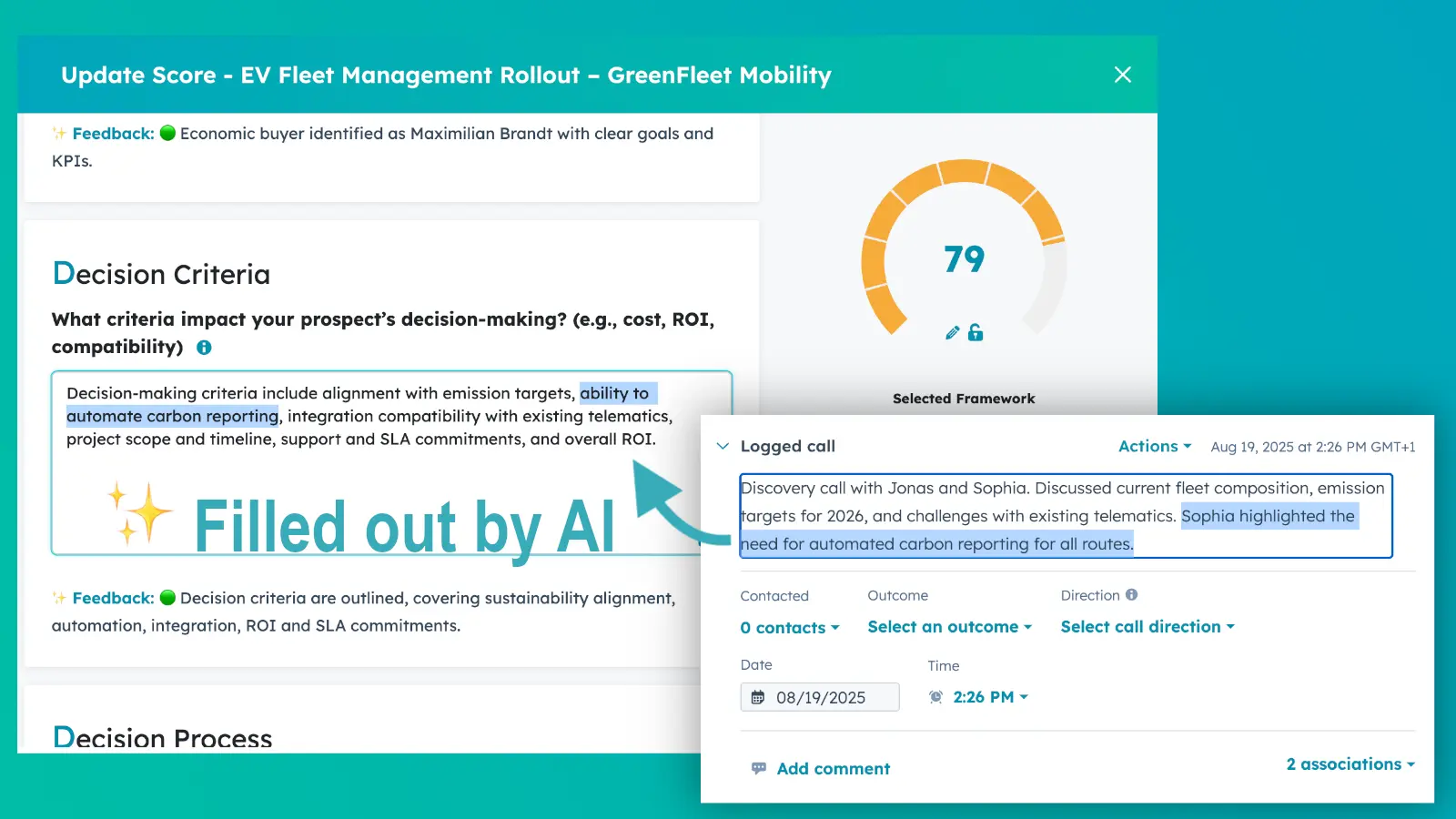
Teams that want a more guided qualification process often complement their CRM fields with a dedicated scoring solution. MEDDICC Score integrates directly with your CRM (HubSpot, Zoho, Salesforce…), automatically analysing notes, calls, meetings, emails and other CRM activity using AI to populate and score MEDDIC criteria. This significantly reduces the manual effort required to maintain qualification data while keeping the structured CRM fields as the single source of truth for filtering, reporting and forecasting.
Recalculate Your Pipeline Coverage
Pipeline coverage shows how many times the open pipeline covers the target for the period.
Its value depends directly on the quality of the opportunities included.
A 3x coverage ratio built on deals without an economic buyer, critical event, or confirmed decision process creates a false sense of security.
Run a simple test:
- Remove opportunities without an identified economic buyer.
- Remove those without a dated decision process.
- Remove those that have not quantified impact.
- In complex cycles, remove those without a documented Paper Process.
- Calculate coverage again.
The gap between both figures represents the risk your current qualification criteria allow into the forecast.
Opportunities without an identified economic buyer
Those without a dated decision process
Those that have not quantified impact
In complex cycles, those without a documented Paper Process
The second number is the one your forecast actually rests on. It is not ours to fill in.
The pipeline coverage calculator lets you compare declared pipeline with genuinely qualified pipeline and measure how much your ability to reach the target changes.
Your next sales review has one direct test. Filter the forecast for opportunities where every criterion has documented evidence, and the number that survives is the pipeline you can actually defend.
Frequently asked